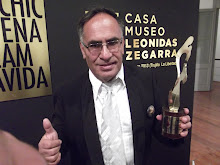
LEÓNIDAS ZEGARRA UCEDA: THE ANTICOMMUNIST FILMMAKER, CINEASTA ANTICOMUNISTA EXTRAORDINARIO.

LEÓNIDAS ZEGARRA UCEDA: THE ANTICOMMUNIST FILMMAKER, CINEASTA ANTICOMUNISTA EXTRAORDINARIO.
LEÓNIDAS ZEGARRA UCEDA Y FERNANDO "HUANCHACO" GUTIÉRREZ
Mostrando entradas con la etiqueta Jorge Luis Villacorta Santamato. Mostrar todas las entradas

viernes, 7 de enero de 2022

María y los niños pobres de Leonidas Zegarra Uceda y la narración paramétrica.

 https://revistasinvestigacion.unmsm.edu.pe/index.php/tesis/article/view/20176/17607

DOI: 

https://doi.org/10.15381/tesis.v14i19.20176

Palabras clave: 

Leonidas Zegarra Uceda, narración paramétrica, estilo cinematográfico, cine digital artesanal latinoamericano, distanciamiento estético

Resumen

Al estudiar el largometraje artesanal pequeñoburgués María y los niños pobres (2010) de Leonidas Zegarra Uceda (2/2/1949-29/12/2020), cineasta peruano, en el marco de la narración paramétrica, teorizada por Noël Burch y David Bordwell, se puede demostrar su originalidad formal como flujo de técnicas fílmicas en cuanto la organización de sus parámetros no se asemeja a la de otras obras hasta donde se conoce. Adicionalmente, en el marco teórico de la sociología de Pierre Bourdieu, se puede demostrar con ejemplos históricos que los artistas e intelectuales que toman posición por la innovación formal en el cine, propia de la práctica del “distanciamiento estético”, lo hacen en lucha contra la “estética popular” sobre la cual la producción industrial dominante en el mercado elabora formas estandarizadas que pretende son los modelos legítimos de “arte cinematográfico”.


Tesis (Lima). Año 15, Vol. 14, Número 19 (2021) Julio-Diciembre
Revista de investigación de la Unidad de Posgrado de la Facultad de Letras y Ciencias Humanas.
Universidad Nacional Mayor de San Marcos.

María y los niños pobres de Leonidas Zegarra Uceda y la narración paramétrica
Leonidas Zegarra’s María y los niños pobres and parametric narration

Resumen
Al estudiar el largometraje artesanal pequeñoburgués María y los niños pobres (2010) de Leonidas Zegarra Uceda (2/2/1949-29/12/2020), cineasta peruano, en el marco de la narración paramétrica, teorizada por Noël Burch y David Bordwell, se puede demostrar  su  originalidad  formal  como  flujo  de  técnicas  fílmicas  en  cuanto  la  organización  de  sus  parámetros  no  se  asemeja  a  la  de  otras  obras  hasta  donde  se  conoce. Adicionalmente, en el marco teórico de la sociología de Pierre Bourdieu, se puede demostrar con ejemplos históricos que los artistas e intelectuales que toman posición por la innovación formal en el cine, propia de la práctica del “distanciamiento estético”,  lo  hacen  en  lucha  contra  la  “estética  popular”  sobre  la  cual  la  producción  industrial dominante en el mercado elabora formas estandarizadas que pretende son los modelos legítimos de “arte cinematográfico”.
Palabras    clave:    Leonidas    Zegarra    Uceda,    narración    paramétrica,    estilo    cinematográfico, cine digital artesanal latinoamericano, distanciamiento estético

Abstract
By studying María y los niños pobres (2010), a petit bourgeois artisanal feature film directed  by  the  Peruvian  filmmaker  Leonidas  Zegarra  (02/02/1949-12/29/2020),  within the theoretical framework of the parametric narration developed by Noël Burch and David Bordwell, it is provable that it has an original film form as a flow of film techniques because the organization of its parameters don’t resemble other movies, considering  what  is  known  today.  Additionally,  within  the  sociological  framework  developed by Pierre Bourdieu, it is demonstrable with historical examples that the artists  and  intellectuals  who  decide  to  support  formal  innovation  in  filmmaking,  attitude  related  to  the  practice  known  as  “aesthetic  distancing”,  do  it  struggling  against the “popular aesthetic” that the industrial production ruling the market uses as a basis to manufacture standardized forms that pretends are the legitimate models of “film as art”.
Keywords:   Leonidas   Zegarra;   parametric   narration;   filmmaking   style;   Latin   American digital artisanal filmmaking; aesthetic distancing.

Fecha de envío: 19/4/2021Fecha de aceptación: 19/3/2021

domingo, 20 de diciembre de 2020

¡PATRICK FOLEY DE "UK FILM REVIEW" COMENTA "THEORETICALLY, A PARANOID CONSPIRATORIAL PHONE CALL" (2,020) LARGOMETRAJE PRODUCIDO POR LEONIDAS ZEGARRA!

THANKS PATRICK FOLEY! THANKS "UK FILM REVIEW"! ¡MUCHAS GRACIAS POR SU COMENTARIO CRÍTICO A MI GRAN PRODUCCIÓN SOBRE ORGANIZACIONES DE ESPIONAJE Y OPERACIONES PSICOLÓGICAS!

https://www.ukfilmreview.co.uk/post/theoretically-a-paranoid-conspiratorial-phone-call-indie-film-review

Theoretically, A Paranoid Conspiratorial Phone Call indie film review

★★

Directed by: Jorge Villacorta

Written by: Jorge Villacorta

Starring: Jorge Villacorta

Film Review by: Patrick Foley

We’re living in a golden age for conspiracies right now. Everyone from Donald Trump to Denise Welch seems to be on the verge of uncovering a grand scheme to explain COVID, the US election and why on earth Arsenal signed Willian. The idea of a master planner behind all the chaos is almost comforting. Theoretically, a paranoid conspiratorial phone call shows that it would be anything but. 

A mysterious figure known only as ‘the boss’ takes a series of phone calls from clients. He is a ‘Pro bono spyhunter’ – the man the spy world calls when they need to reshape political landscapes. But as he becomes embroiled in one scheme, his own reality is called into question. 

Theoretically… is not an easy watch. The film is a conceptual piece in which the audience sees only the spymaster (director and writer Jorge Villacorta) as he partakes in a number of phone calls at his office desk. Viewers are fixed in place for the film’s 90-minute runtime, and only hear the Boss’ side of the call – to give the impression of our viewpoint being that of a hidden camera. Viewers must be prepared to focus intently in order to follow the developments of the plot, and given the unconventional approach, this gets increasingly difficult as the film goes on. The concept is interesting, but does not translate well to a film this long. Similar fixed-location movies such as Locke manage to go the distance by being far more stimulating – plot-wise and visually. Perhaps intentionally, Theoretically… fails to do this. Whatever the director’s intended outcome, it does not serve the film well. 

Jorge Villacorta’s performance is strong as the shadowy and corrupt Boss. His casual, business-like demeanour as he discusses false-flag attacks, faux-revolutions, kidnapping and murder is disturbing and sinister. His arrogance and untouchable manner almost seem unrealistic, but as recent scandals such as the crimes of Cambridge Analytica have taught us, these soulless figures do in fact exist. Whilst the performance is authentic and affecting, it again struggles to sustain the viewer’s interest over the runtime. This is particularly evident as the Boss uncovers shocking information relating to himself – and yet his behaviour seems to change very little. More variation in the performance would have helped keep audiences engaged. 

The film feels very contemporary with the exploration of power, conspiracy and paranoia. Despite its minimalist nature, the director manages to weave in allusions and nods to a variety of topics in the real world. A hint that the spymaster may have impacted Brexit is in plain sight, and his repeated references to using superhero movies as propaganda is a notable embrace of the conspiratorial mind. The boss eventually finds himself drawn into his own web of confusion, perhaps inevitably for someone who lives in a world of lies. The ambiguous and open-ended nature of his calls, and the questions left with the audience at the end of the movie make this an ominous parable for the truth-twisters who serve as the spymaster’s influences. 

Theoretically… is an interesting concept for a movie that is stretched out far too long to maintain the audience’s interest. Jorge Villacorta’s performance fits his vision for the project well, and the film is thought-provoking and modern with its portrayal of conspiracy theories and shadowy figures trying to control our reality. But the reality here - is that as a concept, it simply does not suit a feature film. 

-----